|
At the end of the harvesting season, the combine harvester stops, but it is precisely at this stage — before winter storage — that a PTO shaft reveals what it has really endured during its working hours: not only visible wear, but also fatigue affecting universal joints, safety devices subjected to loads beyond their threshold, and telescopic tubes that have operated close to the limits of their permitted travel. Anyone who works every day with forage harvesters and combine harvesters knows it: a visual inspection alone is not enough; a systematic approach is required.
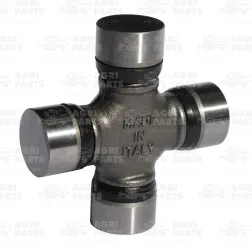
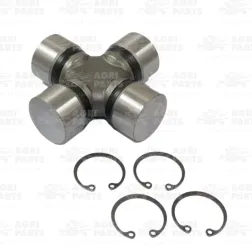
Universal joints and yokes: what to check beyond "checking for play by hand"
Perceptible play by hand in universal joints is the most basic indicator, and it only appears when the damage is already advanced. Before reaching that point, look for the following signs:
· Bearing races (fretting/brinelling): micro-marks on the needle-bearing seats, often caused by prolonged operation at high joint angles or insufficient lubrication. Play may not be immediately perceptible, but it accelerates fatigue failure.
· Cyclic noise correlated with rotational speed (rather than a constant noise): typical of universal joints with damaged bearing races, it becomes more pronounced under load.
· Blocked or missing grease nipples: if grease can no longer reach the bearing races, fretting wear becomes concentrated at the points of maximum working angle.
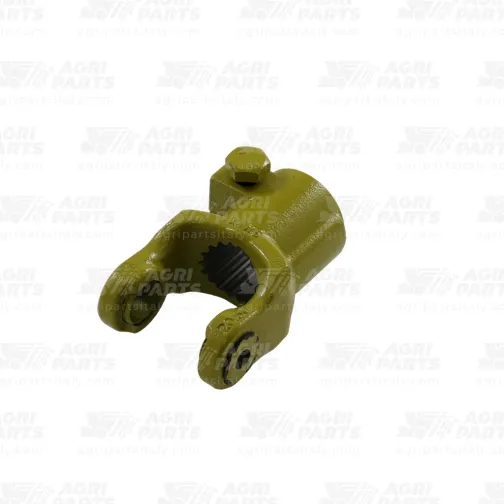
On the yokes, in addition to obvious deformation, it is worth checking the alignment of the keys/pins securing the connection to the PTO: axial play here generates vibrations that are often mistaken for worn universal joints, when the actual problem lies further upstream.
Telescopic tube: between seizure and excessive extension
The triangular (or splined) profile should be assessed from two opposite perspectives:
· Seizure caused by dirt/contaminated or hardened grease: this prevents free sliding and, under working conditions with variations in the distance between the tractor and the machine, can lead to abnormal axial loads on the entire shaft.
· Profile wear caused by excessive play: this manifests itself through torsional vibrations and, in more advanced cases, the risk of the telescopic elements extending beyond their design limit, resulting in loss of engagement between the machines.
Neither condition is acceptable when preparing for the next season: the first must be addressed through cleaning and re-lubrication, while the second requires replacement of the tube.
Torque limiter: the component most often undersized or selected at random
A large part of the transmission's actual reliability depends on this component, and it is also where the most specification errors are made when reordering:
· Friction disc clutch (FD): absorbs torque peaks while maintaining transmission through controlled slippage; suitable for short, repeated overloads, but requires slipping to remain brief — prolonged slippage overheats the discs and rapidly reduces their actual setting.
· Cam/roller torque limiter (LDR/LN type): interrupts transmission sharply once the threshold is exceeded and automatically resets as the speed drops; it should be preferred where an immediate stop of the driven machine is required to prevent breakage (typical of components with high inertia or a risk of sudden blockage).
· Overrunning clutch: it does not limit torque, but prevents the inertia of the implement from continuing to load the PTO during deceleration — often combined with one of the two devices above (FR combined device) to address both risks.
A common workshop mistake is to replace a damaged torque limiter with one that is "equivalent" in terms of mechanical connection but has a different setting from the original, thereby altering the protection threshold specified by the implement manufacturer. The setting must always be checked, not just dimensional compatibility.
Working angles: where theory meets real-world field operation
Simple universal joints are structurally capable of accommodating excursions of up to 35-45°, but the recommended continuous operating range remains 15-20°: above this threshold, even in the absence of immediate symptoms, fretting wear on the universal joints accelerates non-linearly. In configurations that operate consistently at higher angles (some headers, or certain tractor-machine combinations with significant height differences), the constant-velocity shaft is not an optional upgrade but the technically correct choice, because it maintains constant transmission speed even at high angles, avoiding the cyclic irregularities that a simple universal joint would introduce under such conditions.
Guards: not only integrity, but also correct configuration
One point that is often overlooked during inspections: the torque limiter or overrunning clutch must, according to safety specifications, be located on the implement side (driven side) and not on the tractor/self-propelled machine side. Guards must cover the entire length of the shaft and joints on both sides, with the outer elements secured so that they cannot rotate together with the shaft. During the end-of-season inspection, in addition to checking that guards and safety chains are intact, it is worth verifying that this side-to-side configuration is still correct, especially if the shaft has been removed and refitted several times during the season.
Overhaul or replacement: the technical criterion, not just appearance
The decision should be based on three factors, rather than visual inspection alone:
1. Cumulative fretting condition of the universal joints, even when no play can be detected by hand — replacing the universal joints preventively is often more economical than dealing with a failure in the field during the next season.
2. Match between the shaft's nominal category/torque rating and the current tractor power, especially if the machinery fleet has changed since the previous season.
3. Actual torque limiter setting compared with the value required by the implement, which can be verified by comparing the setting value with the equipment's technical documentation, rather than relying solely on the mechanical connection.
When even one of these three points does not match, replacing the complete PTO shaft (or the torque limiter alone) is the technically more robust choice compared with a partial repair.
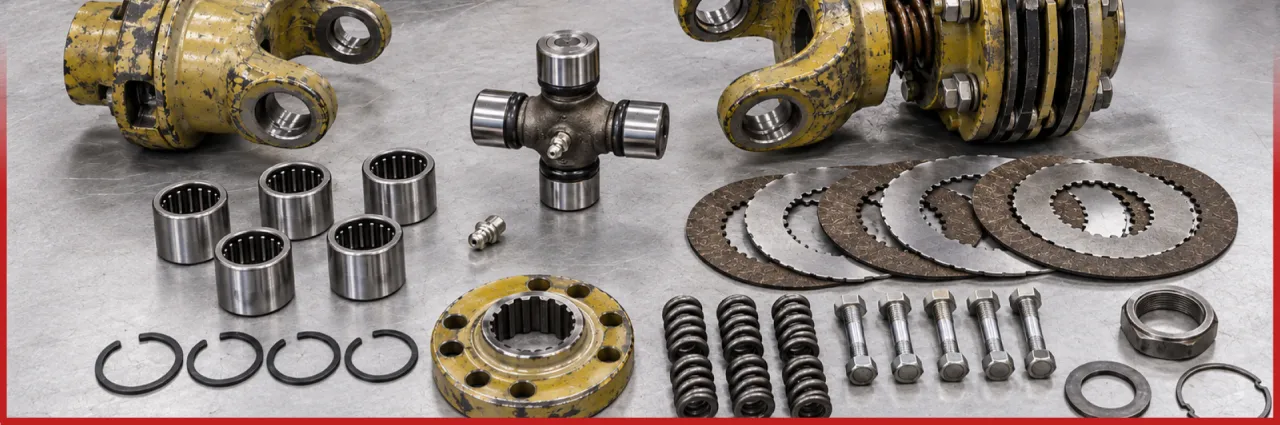
In the catalogue, you will find PTO shafts by category and torque rating, friction torque limiters, cam-type limiters and combined units with overrunning clutch, as well as individual spare parts (universal joints, yokes, telescopic tubes, safety guards) for targeted repairs without replacing the entire shaft when this is not necessary.
|