|
Anyone managing a fleet of agricultural machinery, whether combines, forage harvesters, or balers, knows all too well the invisible enemy of every harvesting season: abrasion. Constant contact with the crop, crop residues, and airborne soil acts like high-speed sandpaper on rotating and cutting components.
When it is time to replace blades, knives, or spacers, the question that inevitably comes to mind when looking through a spare-parts catalogue is always the same: is it worth investing in components with tungsten carbide hardfacing, or is it better to opt for conventional standard alloy steel?
To answer this question, we need to analyse the physics governing material wear and the real impact these materials have on operating costs.
Material Physics: What Is Tungsten Carbide?
Standard steel used for high-quality agricultural spare parts is generally manganese or boron steel, subjected to heat treatment and hardening to increase its surface hardness. It offers excellent impact resistance (essential to prevent breakage when hitting stones), but its cutting edge tends to lose its sharpness relatively quickly.
Tungsten carbide is a cemented composite material consisting of tungsten carbide particles bonded together by a cobalt or nickel matrix.
|
Property
|
Standard Hardened Steel
|
Tungsten Carbide
|
|
Hardness (Vickers Scale)
|
~500–700 HV
|
~1500–2000 HV
|
|
Abrasion Resistance
|
Good (ideal for softer soils)
|
Exceptional (up to 4–5 times higher)
|
|
Impact Behaviour
|
Elastic (bends but is unlikely to chip)
|
Rigid (requires a structural steel base)
|
The secret behind modern high-performance spare parts lies in combining the two worlds: an elastic, resilient steel body with a tungsten carbide hardfacing layer or insert applied precisely to the wear profile.
3 Long-Term Economic Benefits of Tungsten Carbide
1. The “Self-Sharpening” Effect
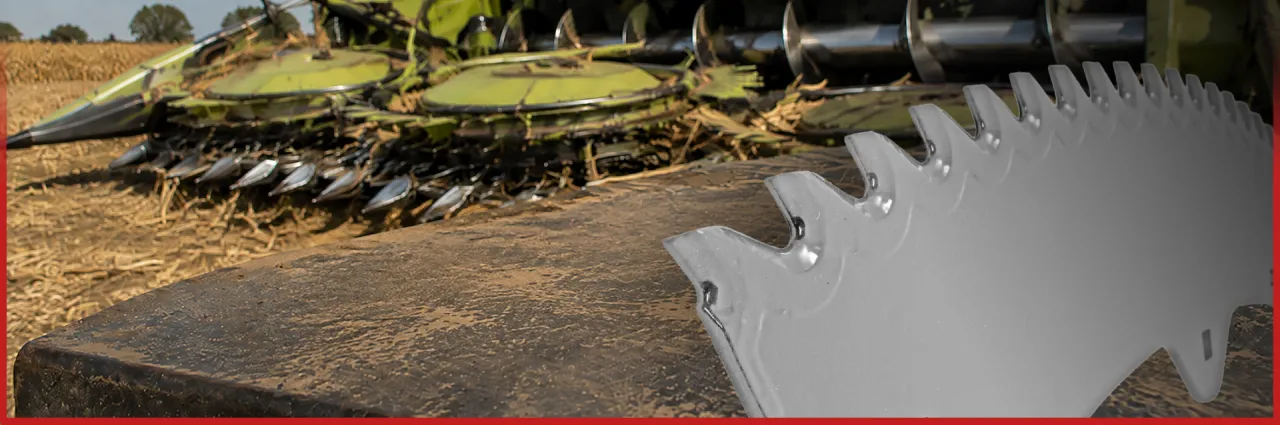
While a standard steel blade becomes uniformly rounded and progressively loses its cutting ability, components with a combined hardfaced design take advantage of differential wear. The underlying steel wears slightly faster than the tungsten carbide layer. This keeps the blade edge structurally sharp throughout the component's service life, ensuring a clean cut from the first to the last hectare.
2. Significant Reduction in Fuel Consumption
A blade that loses its edge no longer cuts properly: it tears. To compensate for the increased effort required by a rotor or cutting bar with blunt blades, the combine or forage harvester engine must deliver more power, operating under greater load. Field studies show that using blades that remain consistently sharp thanks to tungsten carbide can reduce diesel consumption by up to 8–12% per hectare worked.
3. Reduced Downtime
The real cost of a spare part is never just its purchase price; it also includes the time required by the mechanic to remove and replace it. Choosing a component that lasts 3 to 5 times longer means eliminating 3 or 4 additional maintenance sessions during the harvesting season, when every minute of downtime can cost hundreds of euros.
When Is Tungsten Carbide the Right Choice?
Investing in spare parts with tungsten carbide hardfacing offers the greatest economic return under specific conditions:
- Dry, sandy or clay soils: Where airborne dust is highly abrasive.
- Difficult crops: Such as grain maize, sorghum, or fibrous forage (e.g. alfalfa over multiple cuttings), which subject cutting profiles to intermittent and severe stress.
- High-productivity contract farming: Where machines operate intensively and the harvesting operation cannot afford to stop for sharpening or knife replacement.
While standard steel remains an excellent cost-effective solution for machines that operate only a few hours per year on clean soils, tungsten carbide proves to be the strategically and economically superior choice for anyone who considers operating efficiency and cost per hectare to be the key metrics of their agricultural business.
|